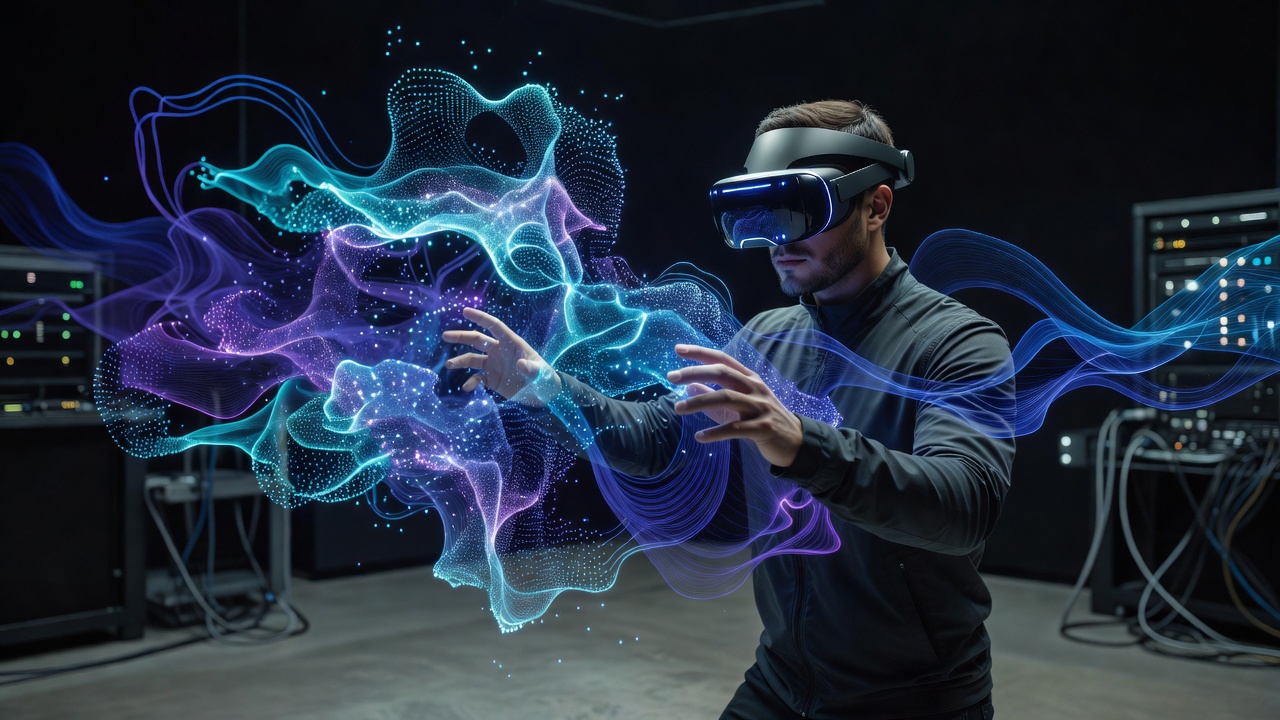
For decades, interactive computer graphics have relied on polygon rasterization pipelines—constructing virtual worlds using thousands of flat geometric faces textured with 2D bitmaps. However, the emergence of Neural Radiance Fields (NeRF) and 3D Gaussian Splatting has fundamentally shifted spatial rendering from manual geometric art to continuous implicit neural representations.
Understanding Neural Implicit Rendering
Neural Radiance Fields use deep neural networks (typically multilayer perceptrons) to represent 3D scenes continuously. Rather than storing coordinates of vertices and triangles, a NeRF models a volumetric scene function: given a 3D spatial coordinate (x, y, z) and a viewing direction (theta, phi), the neural network outputs the emitted RGB color and volume density at that precise point.
Solving the 90 FPS Barrier in Virtual Reality
Historically, the primary bottleneck preventing NeRF integration into extended reality (XR) headsets was computational complexity. Evaluating a neural query for millions of ray samples at dual-display 4K resolutions required supercomputing clusters. Modern advancements in 3D Gaussian Splatting and tensor hardware acceleration now enable real-time rasterization above 90 frames per second on mobile XR processors.
- Instant Scene Digitization: Real-world environments can be reconstructed from 30 seconds of phone camera video.
- Dynamic Relighting: Neural representations natively support environmental reflections, subsurface scattering, and volumetric fog.
- Foveated Neural Cache: Eye-tracking targets neural query compute only where the human fovea is currently looking.
Industrial & Metaverse Implications
As neural rendering algorithms merge with multi-modal generative AI, virtual reality platforms like Gazetteprimescout predict a transition from static digital twins to generative spatial environments generated entirely on-the-fly via spoken context.