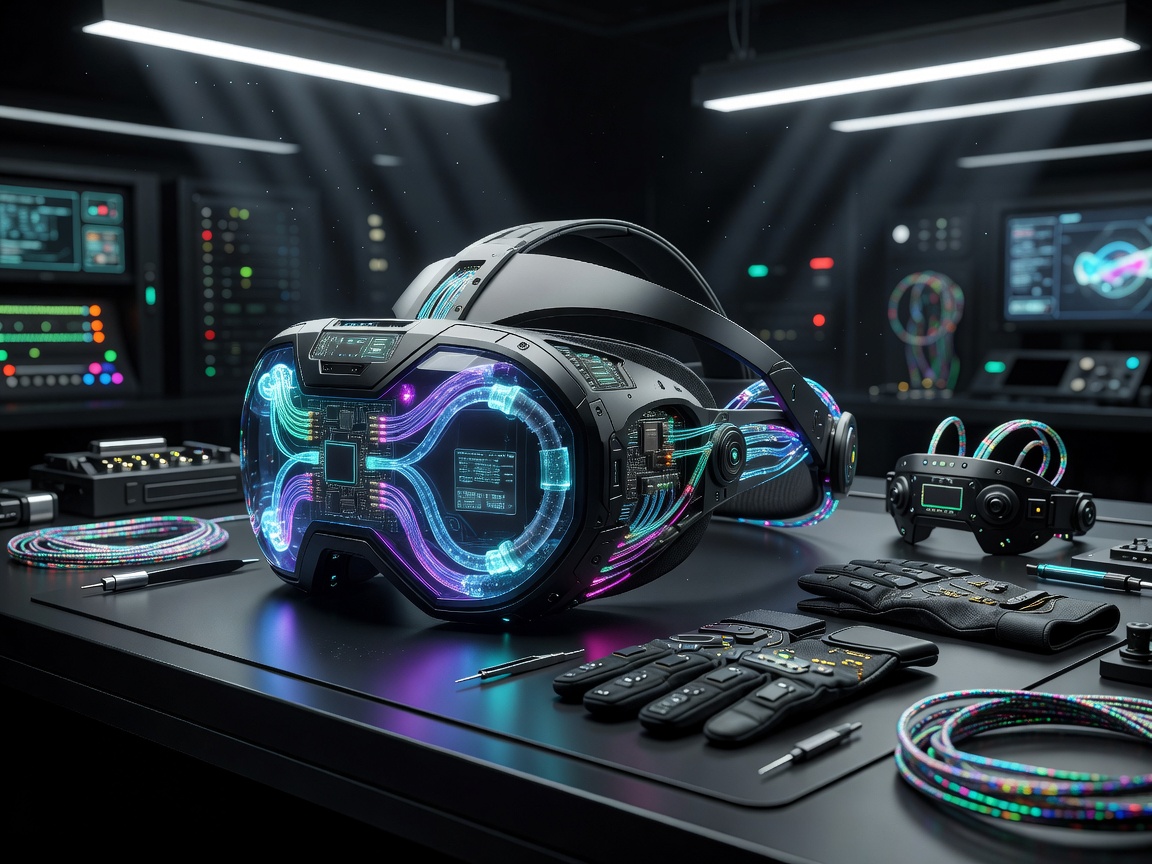
The visual fidelity of spatial computing hardware hinges on two interconnected optical elements: display panel pixel density and light-guide efficiency. As display manufacturers transition from traditional LCD and AMOLED panels to silicon-wafer Micro-OLED (OLEDoS), visual clarity is reaching human retinal limit thresholds.
Surpassing 3,500 Pixels Per Inch (PPI)
Standard VR headsets previously suffered from the "screen-door effect"—visible gaps between individual subpixels. Silicon-backplane Micro-OLED fabrication compresses millions of self-emissive organic diodes into a display panel no larger than a postage stamp, achieving pixel densities exceeding 3,500 PPI.
Waveguide Optics and Luminance Trade-offs
For lightweight augmented and mixed reality eyewear, diffractive planar waveguides offer unparalleled form factors. However, passing light through diffractive gratings incurs significant optical efficiency loss—often exceeding 85%. Recent breakthroughs in high-index glass substrates and nano-imprinted surface relief gratings (SRG) are restoring full daylight readability.
- Dynamic Eye-Box Expansion: Active liquid crystal lenses adjust focal depth continuously to resolve vergence-accommodation conflict.
- Dynamic Refresh Rates: Variable 90Hz to 144Hz panel driving synced with neural eye-tracking foveated pipelines.
- Thermal Management: Aluminum nitride heat spreaders dissipate drive circuit heat away from facial contact points.
What Lies Ahead
As Micro-OLED manufacturing yields normalize and optical efficiencies increase, display hardware will shrink into traditional eyeglasses form factors, setting the standard for pervasive spatial computing.