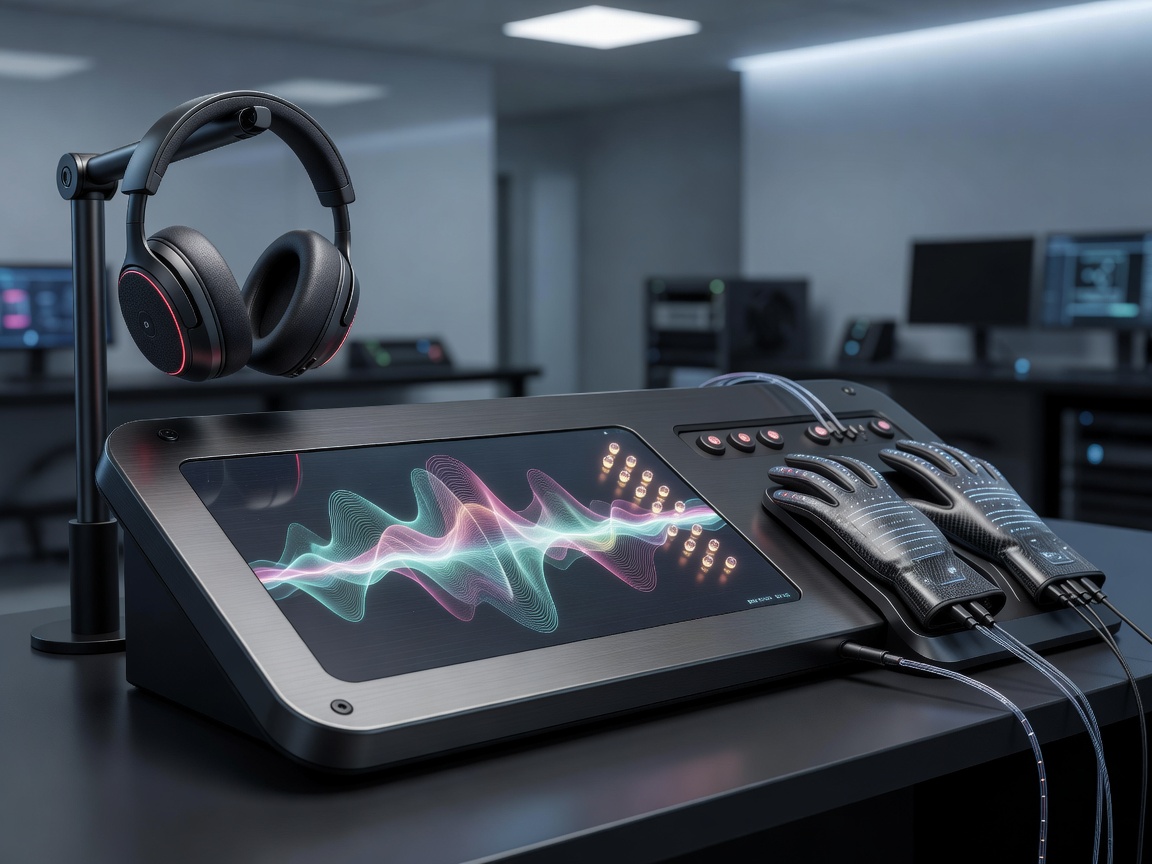
Immersion in extended reality relies on tricking the brain into believing a simulated environment is physical. While high-resolution optics address vision and head-related transfer functions (HRTF) handle spatial sound, tactile sensation has remained a difficult challenge. Neural haptic synthesis offers a breakthrough by converting 3D physics collisions into custom tactile micro-waveforms in real time.
Beyond Pre-Recorded Vibration Clips
Legacy haptic systems rely on pre-baked pulse effects triggered when hand controllers collide with virtual objects. These static clips fail to convey subtle differences in material density, surface friction, or impact velocity. Neural haptic synthesis employs deep generative models to compute dynamic force feedback pulses based on real-time surface topology.
Cross-Modal Acoustic and Tactile Coupling
The human somatosensory system processes tactile vibrations and sound impulses in close coordination. Modern spatial audio engines now generate haptic actuation signals directly from acoustic resonance calculations, ensuring that sound wave reflections match tactile hand vibrations during environmental impacts.
- Material-Aware Resonators: Linear Resonant Actuators (LRAs) vary frequency output dynamically based on object stiffness.
- Sub-Millisecond Neural Latency: Lightweight neural network inferencing executes within 2ms to prevent sensory desynchronization.
- Micro-Fluidic Haptic Wearables: Emerging gloves utilize pneumatic micro-channels powered by neural pressure distribution algorithms.
The Next Frontier in Tactile Realism
As neural haptic synthesis merges with spatial computing operating systems, users will be able to feel virtual objects with distinct tactile feedback, unlocking new possibilities in remote medical training and interactive digital creation.